
E-commerce SEO Strategist
I help e-commerce stores turn organic search visibility into qualified traffic, product discovery, and consistent sales through conversion-focused E-commerce SEO Services.
My approach combines technical SEO, search intent, keyword research, product and collection optimization, internal linking, content strategy, site architecture, and authority building to help your store compete in Google and the evolving AI search landscape.
Shopify + WooCommerce | E-commerce SEO | Google + AI Search
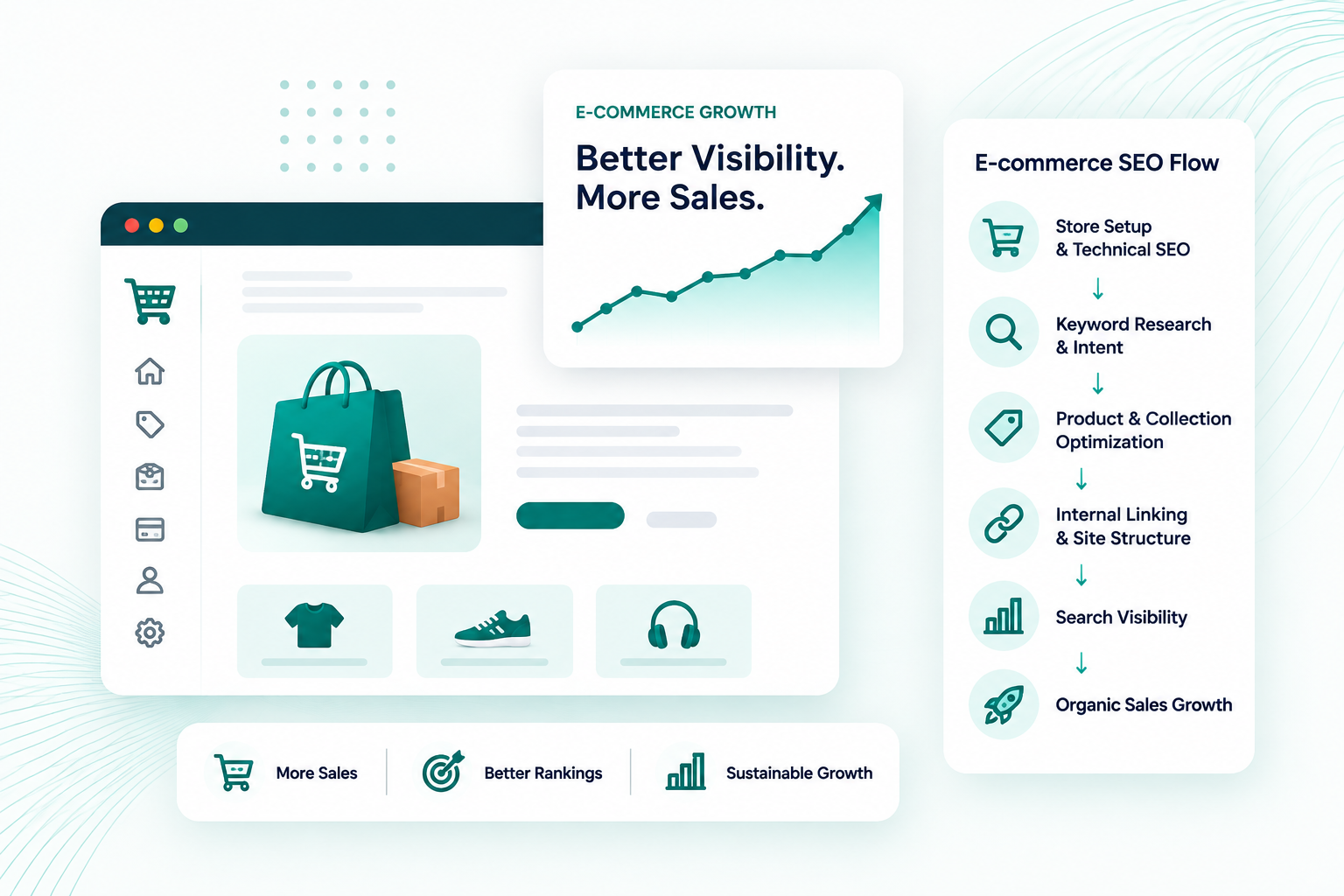
UNDERSTANDING E-COMMERCE SEO
E-commerce SEO is the process of improving an online store's technical foundation, site architecture, product and category pages, content, internal linking, and authority so search engines can better discover, understand, and rank the store for relevant searches.
Unlike traditional SEO, e-commerce SEO has to account for the relationship between commercial search intent and the pages designed to satisfy it.
That means understanding which searches should lead to:
The result is a search strategy designed around how people actually discover and evaluate products.
An online store isn't just a collection of web pages.
It has products, collections, categories, variants, filters, reviews, inventory changes and thousands of URLs that search engines need to understand.
That creates SEO challenges that a generic approach can easily overlook.
A strong e-commerce SEO strategy connects:
Search demand
Site architecture
Technical SEO
Commercial intent
so the pages that matter most to your business can be discovered, understood, and ranked.
The goal isn't simply to generate more organic traffic.
It's to improve visibility where that traffic has the potential to become a customer.
E-commerce Specialization
WHAT I DO
Your store doesn't need more random SEO tasks.
It needs a connected system where technical SEO, search intent, content and commercial pages work together.
Product keywords
Collection and category keywords
Long-tail searches
Commercial investigation queries
Informational searches
Keyword-to-URL mapping
Cannibalization opportunities
The right keyword isn't simply the one with the highest search volume.
I identify the searches that align with your products, customers and commercial goals, then map them to the pages best positioned to satisfy that intent.
Product titles, Product descriptions
Search intent, Product attributes
Internal links, Image optimization
Reviews and supporting content
Product structured data
Variant considerations
Product pages are often the closest organic search touchpoint to a purchase.
I optimize product-page opportunities around relevance, intent, content quality, internal linking and structured information.
The objective is to help search engines and shoppers understand what the product is, who it is for and why it is relevant to the search.
Category and collection intent
Keyword targeting, Page hierarchy
Unique supporting content
Internal linking
Pagination, Filters
Indexation, User experience
Collection and category pages can capture broader commercial searches that individual product pages may not be able to satisfy.
The goal is to turn important category-level pages into meaningful organic entry points, not just navigation pages.
Crawlability, Indexability
Canonicalization, XML sitemaps
Robots.txt, Redirects
Duplicate content, Faceted navigation
Core Web Vitals, URL architecture
Technical SEO provides the foundation for everything else.
I identify issues that can prevent search engines from efficiently crawling, understanding or indexing your store.
Technical SEO, Indexation
Site architecture
Product pages, category pages
Internal linking, Search intent
Content, Structured data
Competitor opportunities
An SEO audit should do more than produce a long list of errors.
It should tell you: What is wrong → Why it matters → What to fix → What to prioritize first
Semantic content structure
Entity clarity
Structured information
Search-intent alignment
Citation-worthy content
Brand authority, AI search readiness
Generative search optimization
Search is becoming more conversational.
Beyond traditional rankings, people are increasingly discovering information through AI-powered search experiences.
I help e-commerce brands strengthen the signals that make their content and brand information easier for modern search systems to understand.
The objective isn't to promise a particular AI citation or ranking.
It's to build a stronger digital presence that can be understood across traditional and emerging search experiences.

Shopify provides a strong foundation for e-commerce, but growing organic visibility requires more than publishing products and waiting for rankings.
A Shopify SEO strategy can address:
Explore Shopify SEO Services →

WooCommerce gives you significant flexibility, but that flexibility also means your SEO strategy needs to account for the underlying WordPress ecosystem.
I can help address opportunities around:
Explore WooCommerce SEO Services →
Depending on your store and engagement, your e-commerce SEO strategy may include:
The exact scope should be based on your store's current situation—not a generic checklist.
SEO isn't always the first thing a business needs.
If you're still validating product-market fit, have little or no search demand, or need immediate sales from a brand-new store, other growth channels may deserve attention first.
E-commerce SEO becomes particularly valuable when you have:
A good SEO strategy starts with understanding whether SEO is actually the right growth lever for your business.
Understand your products, customers, business model, competitors, and organic growth goals.
Identify technical, content, architecture, and search visibility gaps.
Separate high-impact opportunities from low-value tasks so your resources go toward what matters most.
Improve the technical foundation and the commercial pages that have the strongest organic potential.
Strengthen content, internal linking, topical relevance, and authority.
Monitor organic visibility, qualified traffic, rankings and relevant business signals.
Growing Shopify stores looking to build a stronger organic acquisition channel.
Online businesses that need a structured SEO strategy across WordPress and WooCommerce.
Direct-to-consumer brands looking to increase organic visibility around products and commercial search demand.
Businesses that have strong products but aren't getting enough visibility from organic search.
Problem Section
Your products may be indexed but receive little visibility for relevant commercial searches.
Important category or collection pages may not be targeting the right search intent.
Your informational content may attract visitors while the pages designed to generate revenue remain invisible.
Filters, parameters, variants and duplicate pages can create unnecessary crawling and indexing challenges.
Poor keyword-to-URL mapping can cause cannibalization and make it harder for search engines to identify the most relevant page.
As search becomes more conversational and AI-powered, brands also need clear, structured and authoritative information that search systems can understand.
My Approach
I consider why someone searches before deciding what page should rank.
Commercial pages receive strategic attention because they can be closest to revenue.
Technical work is prioritized according to real business and search impact, not automated tool scores alone.
Organic traffic has more value when the landing page helps visitors take the next step.
Traditional SEO and AI-search readiness are treated as connected parts of a modern search strategy.
SEO decisions are informed by search data, competitors, website behavior and performance

Jamshed Bhuiyan is an E-commerce SEO Strategist specializing in Shopify, WooCommerce, technical SEO and AI search optimization.
His approach focuses on connecting search demand with the pages that matter most to an e-commerce business, from products and collections to technical infrastructure and content.
The goal is simple:
Build stronger search visibility that supports sustainable organic growth.
FREE E-COMMERCE SEO AUDIT
Get a practical review of your e-commerce store to uncover technical issues, product and collection page gaps, content opportunities, and other factors affecting your organic visibility.
What ecommerce founders, marketing teams and agency partners usually want to know before we start.
Your store may already have valuable search opportunities.
The challenge is identifying which opportunities matter most—and what should be fixed first.
Let's turn your e-commerce SEO into a structured growth strategy built around your products, customers and search demand.