
E-COMMERCE SEO AUDIT SERVICES
Your store may have technical issues, underperforming product pages, weak categories or collections, search-intent gaps, or missed organic opportunities—but not every SEO problem deserves the same priority.
I provide E-commerce SEO Audit services for Shopify and WooCommerce stores to identify what may be limiting organic visibility, explain why it matters, and turn the findings into a clearer, prioritized SEO roadmap.
The goal isn't to give you another long list of SEO errors.
It's to help you understand what deserves attention first and why.
Technical SEO • Products • Categories & Collections • Keywords • Internal Linking • Content
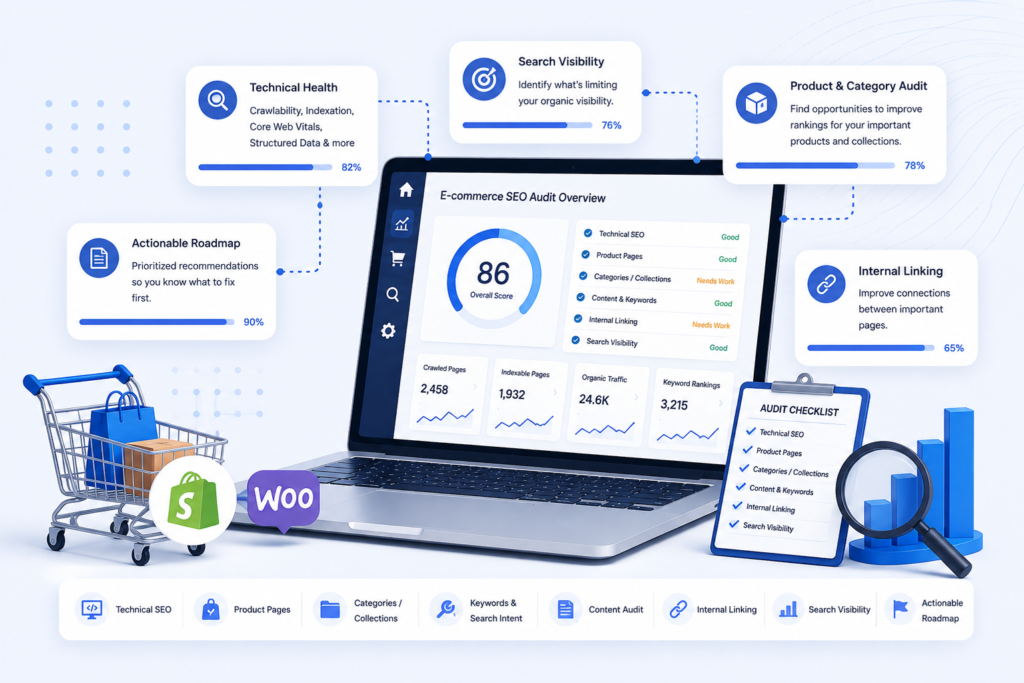
UNDERSTANDING THE AUDIT
An E-commerce SEO Audit is a systematic review of the factors that influence how an online store is discovered, understood, and represented in organic search.
It looks beyond individual SEO errors to evaluate how technical health, keywords, search intent, products, categories or collections, internal linking, and content work together.
As the store grows, this complexity can create technical SEO problems that make it harder for search engines to focus on the URLs that actually matter.
A useful audit should answer four questions:
What Is Wrong?
Identify SEO problems, gaps, and missed opportunities across the store.
Why Does It Matter?
Understand whether each finding can meaningfully affect search visibility or important commercial pages.
What Should Change?
Turn findings into clear and actionable SEO recommendations.
What Should Happen First?
Prioritize recommendations based on potential impact, scale, and business importance.
A useful SEO audit shouldn't leave you with a longer problem list. It should leave you with a clearer plan.
The goal isn't simply to audit a website. It's to understand how SEO is working across an e-commerce search ecosystem.
WHY SPECIALIZATION MATTERS
A standard website and an online store can have very different SEO environments.
E-commerce websites often contain products, categories, collections, variants, filters, parameters, structured product information, and large internal linking systems.
That means an E-commerce Website SEO Audit needs to look beyond basic metadata and technical errors.
SIGNS TO LOOK FOR
Your traffic, impressions, rankings, or commercial-page visibility have dropped, and the reason isn't clear.
Your priority products exist on the website but struggle to gain meaningful organic visibility.
Important category or collection pages aren't capturing broader commercial searches.
Your blog or informational content may attract visitors while product and category pages remain weak.
Products, collections, categories, filters, and URLs have expanded without a wider SEO review.
Changes to URLs, navigation, templates, content, or platform structure may have affected search signals.
Important pages aren't being indexed as expected, or low-value URLs are appearing in search.
SEO tools show dozens or hundreds of issues, but it's unclear which ones actually deserve your time and resources.
E-COMMERCE SEO AUDIT SERVICES
Every store has different SEO challenges, so an audit shouldn't be based on a rigid checklist alone.
I evaluate the areas that can influence how important e-commerce pages are discovered, understood, and positioned in organic search.
Crawlability, Indexation
Canonical signals, XML sitemaps
Robots directives, Duplicate URLs
Faceted navigation
Structured data
Core Web Vitals
Technical site architecture
Analyze technical factors that may affect how search engines crawl, index, and understand your online store.
Identify technical barriers that may be limiting important pages or creating unnecessary search complexity.
Existing keyword targeting
Product keywords
Category/collection keywords
Commercial search intent
Informational search intent
Keyword-to-page alignment
Keyword overlap
Cannibalization opportunities/issues
Missed search demand
Evaluate whether your products, categories, collections, and supporting content are targeting relevant searches with the right type of page.
Identify gaps between what potential customers search for and the pages your store currently provides.
Product keyword targeting
Search intent alignment
Product titles
Meta titles and descriptions
Product descriptions, Heading structure
Product attributes, Image SEO
Structured information
Internal linking, Content gaps
Evaluate important product pages to understand whether they clearly communicate relevance to both search engines and potential customers.
Identify opportunities to strengthen important product pages around relevant product searches.
Keyword targeting, Search intent
Category/collection structure
Titles and headings, Introductory content
Metadata, Internal linking
Product relationships, Filters
Indexation, Search opportunities
Evaluate whether your category or collection pages are positioned to capture broader commercial search demand.
Identify opportunities to strengthen some of the most important commercial landing pages within your store.
Page hierarchy, Crawl depth
Internal linking, Orphan pages
Product-to-category relationships
Product-to-collection relationships
Navigation pathways, Contextual links
Commercial page prominence
Internal authority distribution
Evaluate how products, categories, collections, content, and other important pages connect throughout the website.
Identify opportunities to make important pages easier for both users and search engines to discover.
Existing content coverage
Informational vs commercial content
Search-intent gaps, Content overlap
Supporting content opportunities
Content-to-commercial-page relationships
Topic gaps
Search visibility opportunities
Evaluate how existing content supports search demand, commercial pages, and the wider organic visibility of your store.
Identify where content can better support products, categories, collections, and the customer search journey.
Core SEO principles remain consistent, but the areas that need investigation can vary by e-commerce platform.
My primary platform focus is Shopify and WooCommerce.

A Shopify SEO audit considers how the platform's products, collections, variants, themes, apps, URL behavior, and technical environment influence organic search visibility.
Areas I review:
Explore Shopify SEO →

A WooCommerce SEO audit considers how WordPress, products, categories, attributes, filters, plugins, themes, and store configuration influence organic search visibility.
Areas I review:
Explore WooCommerce SEO →
MY SEO AUDIT PROCESS
Understand your business, platform, products, priority categories or collections, customers, and SEO objectives.
Business → Platform → Products → Goals
Gather the search, website, and SEO information needed to evaluate current performance and potential issues.
Search Data → Website Data → SEO Signals
Evaluate technical SEO, keywords, commercial pages, content, site structure, and internal relationships.
Technical → Keywords → Pages → Content → Structure
Separate symptoms from underlying SEO problems and determine what may actually be limiting visibility.
Finding → Cause → Impact
Evaluate findings according to SEO impact, scale, commercial importance, and implementation considerations.
Impact → Scale → Business Value → Priority
Turn the most important findings into a clearer sequence of recommended actions.
Finding → Recommendation → Priority → Next Step
FROM FINDINGS TO DECISIONS
SEO tools can identify hundreds of potential issues.
But treating every warning as equally important can waste time, budget, and development resources.
That's why I prioritize audit findings using four factors:
SEO Impact
Could the issue meaningfully affect crawling, indexation, relevance, search understanding, or organic visibility?
Commercial Importance
Does the issue affect important products, categories, collections, or other business-critical pages?
Scale
Does the finding affect one page, or hundreds or thousands of URLs?
Effort & Complexity
How difficult is the recommendation to implement relative to its potential value?
The result can then be organized into:
High Priority
Issues and opportunities that deserve attention first.
Medium Priority
Meaningful improvements that can follow the most important work.
Lower Priority
Items worth understanding but not necessarily worth immediate resources.
The goal isn't to fix the most issues. It's to make the best SEO decisions in the right order.
WHAT YOU'LL GET
An audit should help you make decisions, not leave you wondering what a spreadsheet of errors actually means.
Clear SEO Findings
A structured view of the major issues and opportunities identified across the store.
Context Behind the Findings
An explanation of why important findings matter from an SEO perspective.
Prioritized Recommendations
Clear direction around what deserves attention first, what can wait, and why.
Commercial Page Opportunities
Insights around important products, categories, and collections that may need stronger optimization.
Technical SEO Findings
Technical issues affecting crawling, indexation, site understanding, or performance.
Keyword & Search Intent Opportunities
Gaps between existing pages and relevant customer search behavior.
Internal Linking & Structure Opportunities
Recommendations for improving relationships and discovery pathways between important pages.
Action Roadmap
A clearer sequence of recommended next steps based on the audit findings.
STRATEGY OVER CHECKLISTS
A useful SEO audit shouldn't create unnecessary work simply because a tool generated a warning.
I Don't Treat Every Tool Warning as Critical
SEO tools provide useful data, but context determines whether an issue actually deserves attention.
I Don't Prioritize Traffic Without Commercial Relevance
More traffic isn't automatically better if it doesn't support the products and pages that matter to the business.
I Don't Separate Technical SEO From the Bigger Picture
Technical findings need to be considered alongside keywords, search intent, commercial pages, and content.
I Don't Recommend Changes Without a Reason
Every meaningful recommendation should answer: What is the problem, why does it matter, and why should it be prioritized?
I Don't Position an Audit as Development Work
When a recommendation requires advanced coding or development, I can provide the SEO requirements and context for your developer or development team to implement.
IS THIS RIGHT FOR YOUR STORE?
You want a clearer understanding of the SEO issues and opportunities across your Shopify store.
You need an e-commerce-focused review of your WooCommerce site's technical, commercial, and content SEO.
Traffic, rankings, impressions, or important commercial pages aren't performing as expected.
Your store has expanded, and you need to understand whether the SEO foundation has kept pace.
You want to know where your biggest opportunities are before committing significant resources.
You know SEO needs improvement, but you don't know where the highest-value starting point is.
THE RIGHT SERVICE AT THE RIGHT TIME
A full E-commerce SEO Audit isn't automatically the right starting point for every business.
If you're launching a brand-new store with very few products, limited search demand, and almost no established website structure, building the SEO foundation may be more valuable than auditing something that hasn't had time to develop
.Likewise, if you already know the exact technical problem and only need advanced development implementation, a comprehensive SEO audit may be unnecessary.
And if fundamental issues such as product-market fit, pricing, or conversion are the primary challenge, those may deserve attention before a deeper SEO investment.
The purpose of an audit isn't to sell more SEO work. It's to create clarity around whether SEO has meaningful problems and opportunities worth addressing.

I'm Jamshed Bhuiyan, an E-commerce SEO Strategist focused on helping Shopify and WooCommerce brands build stronger organic search visibility.
I approach an SEO audit as a decision-making process—not simply an error report.
That means looking at technical SEO alongside search intent, products, categories, collections, content, and internal relationships to understand how the different parts of the store work together.
My audit approach revolves around three questions:
What's limiting visibility?
Why does it matter?
What should happen next?
My work sits at the intersection of: E-commerce + SEO Strategy + Technical SEO + Search Intent + AI Search
Not every store needs a comprehensive audit immediately.
That's why the initial free review and the full E-commerce SEO Audit serve different purposes.
Designed for businesses that need deeper analysis and clearer strategic direction.
Includes broader analysis of:
Request a Comprehensive SEO Audit →
Designed as an initial, high-level look at your store.
Best for:
Request My Free SEO Review →
What ecommerce founders, marketing teams and agency partners usually want to know before we start.
You don't need another SEO tool telling you that your store has hundreds of errors.
You need to understand which issues may actually be limiting organic visibility, which opportunities matter to your commercial pages, and what deserves attention first.
Let's turn SEO uncertainty into a clearer plan.