
AI SEO FOR E-COMMERCE
Search is evolving beyond traditional rankings.
Customers can now discover products, compare options, ask questions, research brands, and make buying decisions through traditional search results as well as AI-powered search experiences.
I help Shopify and WooCommerce brands strengthen the content, entities, structure, and search signals that make their information easier for both traditional and AI-powered search systems to discover, understand, and interpret.
The goal isn't to chase every new AI trend.
It's to build a stronger search foundation for how discovery is evolving.
AI Search • AEO • GEO • Semantic SEO • Entity Optimization • Structured Information
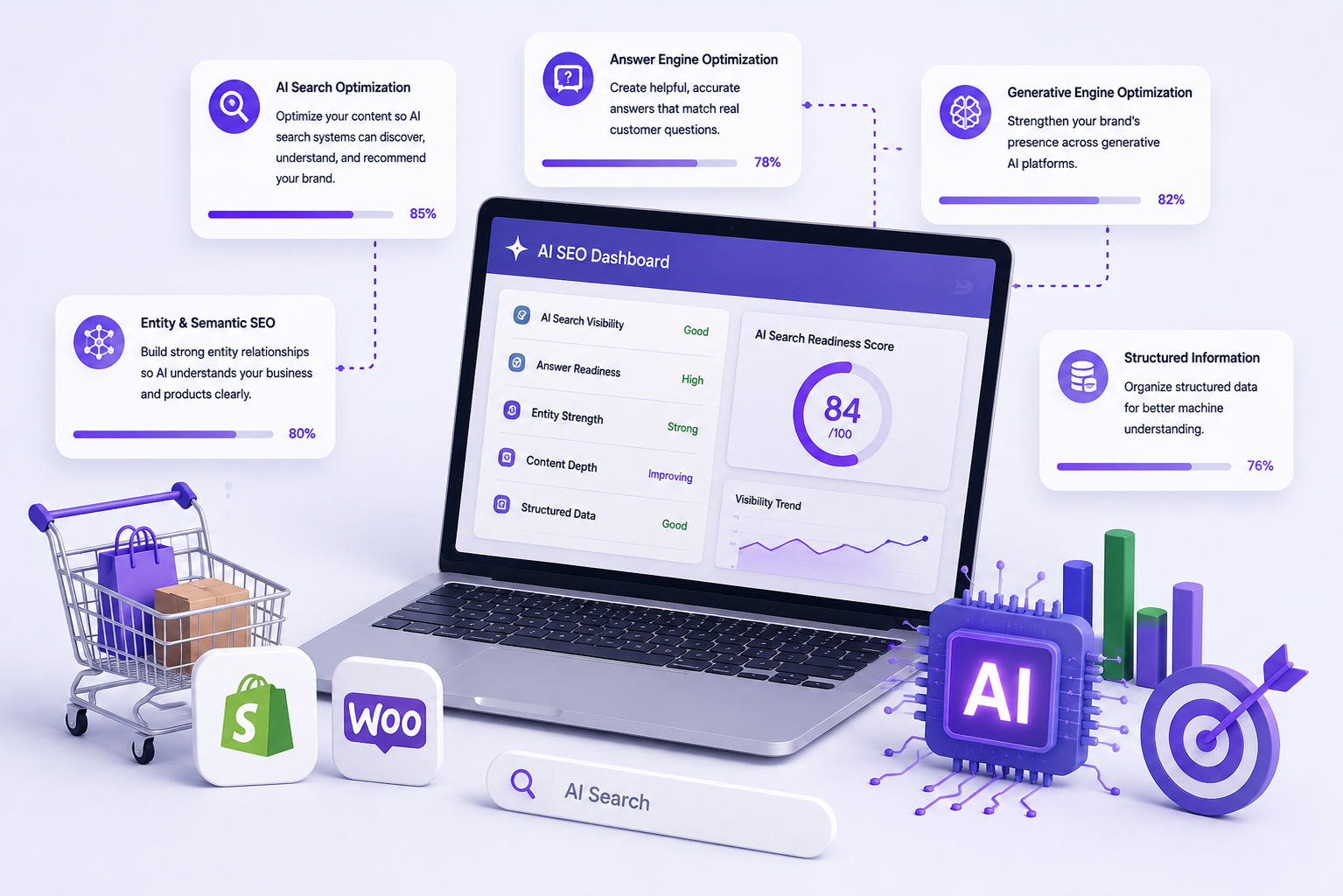
UNDERSTANDING AI SEARCH
AI SEO for E-commerce is the process of strengthening how clearly an online store's brand, products, categories, collections, expertise, and content can be discovered and understood across traditional and AI-powered search experiences.
Traditional SEO remains the foundation.
AI SEO builds on that foundation by placing greater emphasis on contextual clarity, entities, semantic relationships, useful answers, structured information, and content that clearly communicates meaning.
As the store grows, this complexity can create technical SEO problems that make it harder for search engines to focus on the URLs that actually matter.
A strong AI SEO foundation connects:
Traditional SEO
Ensure important pages can be discovered, crawled, indexed, and understood.
Semantic Relevance
Provide enough contextual depth for search systems to understand what a page, product, or topic is really about.
Entity Clarity
Create clearer relationships between your brand, products, categories, topics, and expertise.
Answer-Friendly Content
Provide useful information that directly addresses the questions customers ask during their buying journey.
Structured Information
Organize important product and business information in ways that support clearer machine understanding.
AI SEO doesn't replace traditional SEO. It extends a strong SEO foundation into an evolving search environment.
THE CHANGING SEARCH JOURNEY
For years, the typical search journey looked relatively simple:
Search Query → Search Results → Website
That journey is becoming more diverse.
Customers can now ask detailed questions, request comparisons, explore recommendations, summarize product information, and research purchasing decisions through AI-powered search experiences.
The journey may increasingly look like:
Question → AI-Assisted Answer → Brand/Product Discovery → Website
Or:
Product Need → Comparison → Recommendation → Brand Discovery
This doesn't mean traditional search is disappearing.
It means brands increasingly need information that can be understood across multiple search and discovery environments.
For e-commerce businesses, that makes clarity around products, categories, entities, attributes, expertise, and customer questions increasingly important.
Traditional SEO helps build search visibility. AI SEO extends that foundation toward how modern search systems understand and synthesize information.
Primarily focuses on:
Adds greater emphasis on:
ONE SEARCH FOUNDATION, EXPANDING DISCOVERY
AI SEO shouldn't operate as a separate replacement for your existing SEO strategy.
The strongest approach connects both.
WHAT MAY BE HOLDING YOUR BRAND BACK
Your website may not clearly communicate who the brand is, what it sells, who it serves, and how it relates to its core product categories.
Product pages may contain basic specifications but lack useful context around features, use cases, differences, customer questions, or purchasing considerations.
Categories and collections may simply list products without clearly explaining the product group, customer need, topic, or search intent behind the page.
Important information may be scattered across product pages, FAQs, blog posts, policies, and other areas without clear contextual relationships.
Important information about products, offers, breadcrumbs, organizations, and page relationships may not be represented as clearly or consistently as it could be.
A brand may lack sufficient supporting content, consistent identity signals, useful expertise, references, or external recognition around the topics it wants to be associated with.
E-COMMERCE AI SEO SERVICES
AI SEO isn't about inserting a few extra keywords or adding an FAQ section to every page.
I focus on improving the clarity, structure, relevance, and relationships that help search systems better understand your brand and its information.
Existing search visibility
Brand representation
Product information
Content coverage
Search intent, Entity clarity
Information gaps
Competitor positioning
AI search readiness
Evaluate how clearly your brand, products, categories, and content are positioned across modern search environments.
Identify gaps that may make your brand or important commercial information harder for modern search systems to discover and understand.
Topic coverage
Search intent
Related entities
Supporting concepts
Content structure
Contextual relationships
Information completeness
Content overlap
Improve the contextual depth and semantic relationships within important commercial and informational pages.
Help important pages communicate their topic, purpose, relationships, and relevance more clearly.
Question-based searches
Direct answers, Definitions
FAQ opportunities
Comparison content
Buying questions
Content hierarchy
Answer-friendly formatting
Supporting context
Structure useful information so your content can answer relevant customer questions more clearly and efficiently.
Make useful information easier to identify and extract while still creating a strong experience for human visitors.
Entity clarity, Content structure
Information consistency
Semantic relationships
Source quality
Supporting evidence
Brand authority signals
Citation-worthy information
Strengthen the information and signals that can improve your brand's readiness for generative search environments.
Improve how clearly your brand and content can be interpreted within generative search environments.
GEO improves readiness and discoverability; it cannot guarantee that a specific AI system will cite or recommend a brand.
Brand entity, Product entities
Category relationships
Product attributes
Organization information
Author/expert signals
Entity consistency
Supporting content relationships
Strengthen the relationships between the important entities that define your online store.
For an e-commerce brand, those relationships can include:
Brand → Categories → Products → Attributes → Topics → Expertise
Help search systems better understand who your brand is, what it offers, and how its products and topics relate to one another.
Product information
Organization information
Product attributes
Breadcrumb relationships
Existing structured data
Content hierarchy
Information consistency
Structured data opportunities
Evaluate how clearly important business, product, and page information is organized for search and machine understanding.
Identify opportunities to make important information clearer, more consistent, and easier for search systems to interpret.
Implementation note: Where advanced structured-data implementation requires development work, I provide SEO recommendations that can be implemented by your developer or development team.
AI SEO WITH COMMERCIAL CONTEXT
Generic AI SEO often focuses heavily on informational content.
But an e-commerce search ecosystem is built around relationships between brands, products, categories, attributes, customer needs, and purchasing decisions.
A clearer e-commerce information ecosystem looks like:
Brand
↓
Categories / Collections
↓
Products
↓
Attributes & Features
↓
Customer Questions
↓
Supporting Content
For important products, search systems should ideally be able to understand questions such as:
What is this product?
Which category does it belong to?
Who is it designed for?
What are its important attributes?
What problem or need does it address?
How is it different from related products?
What information helps someone make a purchasing decision?
That's why E-commerce AI SEO isn't simply about optimizing blog articles for AI-generated answers.
It's about strengthening the information ecosystem surrounding your products and brand.
The principles of AI search optimization remain similar, but product and category information is organized differently across e-commerce platforms.
My primary focus is Shopify and WooCommerce.

Help create clearer relationships between Shopify products, collections, content, brand information, and customer search intent.
Areas I focus on:

Help create clearer relationships between WooCommerce products, categories, attributes, content, and brand information.
Areas I focus on:
MY AI SEO PROCESS
Understand your business, products, audience, commercial priorities, core topics, and current search presence.
Brand → Products → Audience → Goals
Evaluate existing search visibility, content, entities, information structure, and AI-search readiness.
Search → Content → Entities → Structure
Connect your brand, products, categories, attributes, topics, customer questions, and search intent.
Entity → Relationship → Intent → Context
Improve important content, contextual relationships, answer structures, and information clarity.
Content → Context → Answers → Relevance
Improve entity clarity, structured information, supporting content, and authority signals.
Entities → Structure → Evidence → Authority
Observe changes across traditional and emerging search environments and identify opportunities for continued improvement.
Visibility → Insights → Opportunities → Refinement
SEO BEFORE AI SEO
AI SEO shouldn't be used to hide weaknesses in basic SEO.
If search engines struggle to crawl your website, important products aren't indexed, commercial pages don't satisfy search intent, or content lacks useful information, adding “GEO” tactics on top won't solve the underlying problem.
A stronger progression looks like:
Technical Foundation
↓
Search Intent & Keywords
↓
Useful Commercial Content
↓
Semantic & Entity Clarity
↓
Structured Information
↓
AI Search Readiness
This is why I approach AI SEO as part of a broader e-commerce search strategy rather than as a standalone shortcut.
IS AI SEO RIGHT FOR YOUR STORE?
You want your product, collection, and brand information structured for both traditional and evolving search experiences.
You want stronger relationships between products, categories, attributes, content, and search intent.
You already have substantial information but need clearer semantic relationships between content and commercial pages.
You understand that search behavior is evolving and want to build a stronger foundation rather than chase temporary tactics.
Your products contain attributes, specifications, use cases, comparisons, and customer questions that need clearer organization.
You want your brand and product information to become easier for emerging search systems to understand.
WHAT AI SEO CAN, AND CANNOT DO
AI-powered search systems determine their own answers, sources, citations, and recommendations.
No legitimate SEO strategy can guarantee that ChatGPT, Google AI experiences, Gemini, or another AI system will mention, cite, rank, or recommend a specific website, brand, or product.
What AI SEO can help strengthen is:
My approach therefore isn't based on promising AI citations.
It's about making your e-commerce information clearer, more useful, better connected, and better prepared for both traditional and emerging search environments.

I'm Jamshed Bhuiyan, an E-commerce SEO Strategist focused on helping Shopify and WooCommerce brands strengthen organic search visibility across both traditional and evolving search environments.
I approach AI SEO as an extension of strong SEO fundamentals—not as a replacement for them.
That means connecting technical SEO, search intent, commercial pages, useful content, semantic relationships, entities, and structured information into a clearer search ecosystem.
My work sits at the intersection of:
E-commerce + SEO Strategy + AI SEO + AEO + GEO + Semantic Search
FREE E-COMMERCE SEO REVIEW
Get an initial review of your e-commerce store to identify SEO, content, structural, and search visibility gaps that may deserve closer attention.
No generic checklist. The goal is to identify meaningful search gaps and opportunities that may deserve your attention.
FREQUENTLY ASKED QUESTIONS
What ecommerce founders, marketing teams and agency partners usually want to know before we start.
Search is evolving, but the fundamentals of useful information, clear relationships, strong commercial pages, and trustworthy content still matter.
Build a stronger search foundation that helps your store become easier to discover and understand across both traditional and emerging search experiences.