
E-COMMERCE TECHNICAL SEO SERVICES
Technical SEO issues can quietly limit how search engines crawl, index, and understand the products, categories, collections, and other important pages across your online store.
I provide E-commerce Technical SEO services for Shopify and WooCommerce stores, helping identify technical search problems, understand their potential impact, prioritize what actually matters, and create clear recommendations for improvement.
The goal isn't to chase every technical warning. It's to build a cleaner, more search-friendly foundation around the pages that matter to your business.
Crawlability • Indexation • Canonicalization • Faceted Navigation • Structured Data • Core Web Vitals
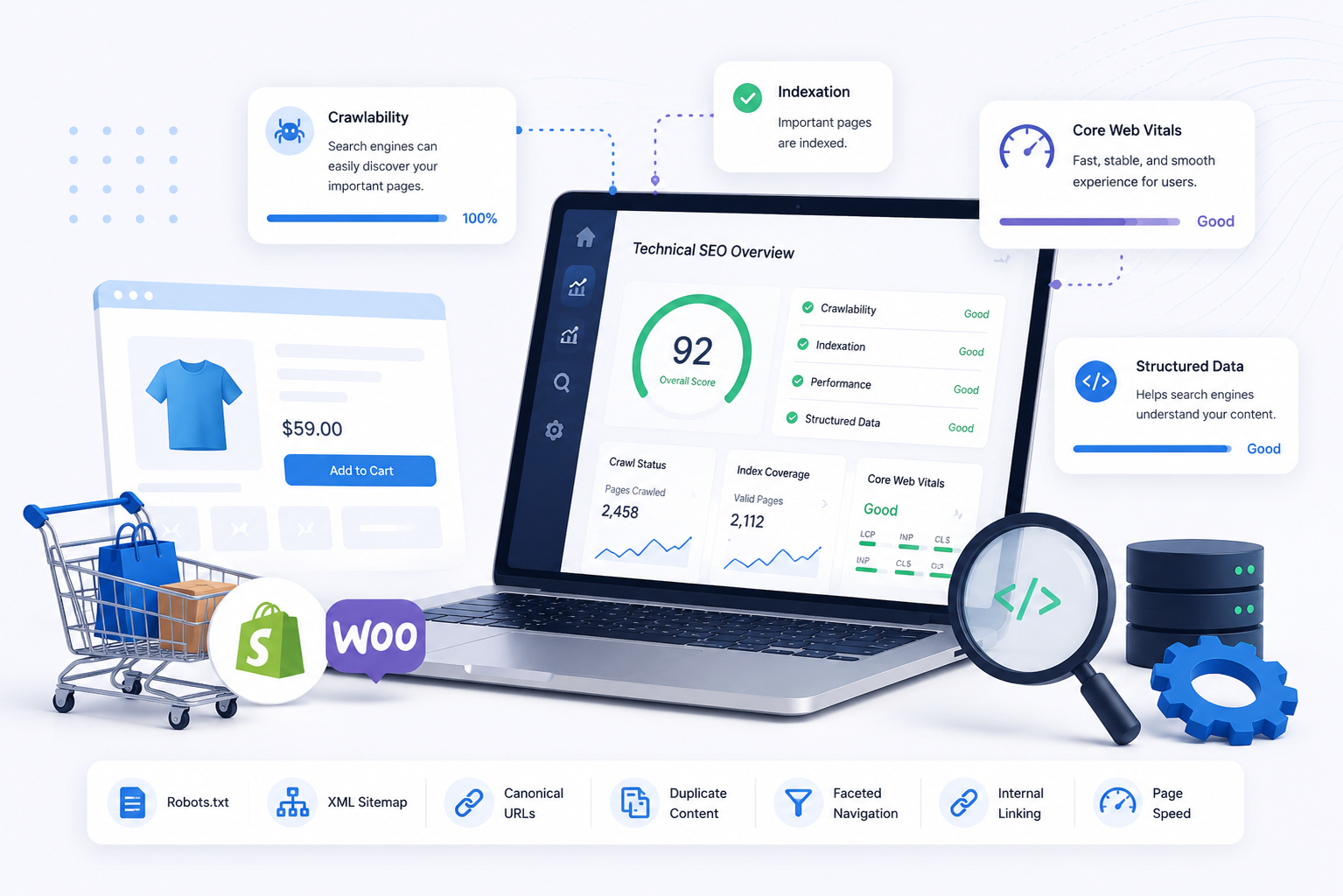
UNDERSTANDING TECHNICAL SEO
E-commerce Technical SEO focuses on improving the technical signals and structure that influence how search engines discover, crawl, index, and understand an online store.
Unlike smaller websites, e-commerce stores can contain hundreds or thousands of products, categories, collections, variants, filters, parameters, pagination URLs, and other dynamically generated pages.
As the store grows, this complexity can create technical SEO problems that make it harder for search engines to focus on the URLs that actually matter.
A strong technical SEO foundation therefore starts with three fundamental questions:
Can Search Engines Crawl Your Important Pages?
Important products, categories, and collections need clear discovery paths so search engines can efficiently access them.
Are the Right Pages Being Indexed?
More indexed URLs aren't automatically better. The goal is to help search engines focus on useful and strategically important pages.
Can Search Engines Understand Your Store?
Canonical signals, structured data, internal relationships, URL patterns, and site architecture all contribute to how search engines interpret your website.
E-commerce Technical SEO creates a cleaner path between your important commercial pages and the search engines trying to discover and understand them.
It's about understanding which technical issues can affect important pages at scale, and deciding which ones deserve attention first.
This means technical SEO for an online store isn't simply about finding errors.
WHY SPECIALIZATION MATTERS
Technical SEO principles apply to many types of websites, but technical SEO for e-commerce becomes more complex because online stores operate at a different scale.
A standard business website may have a relatively small number of stable pages.
An e-commerce website can continuously generate and change URLs through products, categories, collections, filters, variants, pagination, inventory changes, and platform functionality.
COMMON TECHNICAL SEO CHALLENGES
Important products, categories, or collections may be difficult for search engines to discover efficiently because of weak crawl pathways or site structure.
Low-value URLs may enter the index while strategically important commercial pages receive less search visibility.
Product variants, parameters, filters, tags, and platform-generated URLs can create multiple pages with similar or overlapping content.
Incorrect or inconsistent canonical signals can make it harder for search engines to determine which URL should represent a particular page or piece of content.
Product filters can create large numbers of URL combinations, increasing crawl complexity and potentially generating low-value indexable pages.
Themes, apps, plugins, scripts, images, and third-party functionality can contribute to performance problems on important store pages.
Missing, incomplete, duplicated, or conflicting structured data can make product and business information harder for search engines to interpret.
Important commercial pages may sit too deep within the store, receive insufficient internal links, or become effectively orphaned.
BUILDING THE FOUNDATION
Keyword research, product optimization, category content, and internal linking all matter, but they work better when search engines can efficiently access and understand the website supporting them.
More Efficient Crawling
Help search engines spend more attention on useful URLs rather than unnecessary URL combinations.
Cleaner Indexation
Create clearer signals around which pages should be available and valuable in organic search.
Better Search Understanding
Strengthen the technical signals that help search engines interpret products, categories, collections, and their relationships.
Stronger Commercial Page Foundation
Reduce technical barriers that may prevent important product and category pages from performing as effectively as they could.
Better Performance Awareness
Identify Core Web Vitals and performance issues that may require further attention.
More Scalable SEOReduce technical complexity before it becomes harder to manage as your product catalog and website grow.
Technical SEO doesn't create search demand. It helps ensure technical barriers aren't preventing your store from competing for the demand that already exists.
E-COMMERCE TECHNICAL SEO SERVICES
My approach isn't based on fixing every warning an SEO tool can generate.
I analyze technical SEO issues in the context of search impact, scale, commercial importance, and priority, then provide clear recommendations around what deserves attention.
Crawlability, Indexation patterns
Robots directives, XML sitemaps
Noindex usage, Crawl pathways
Orphan pages, Crawl depth
Index coverage
Understand how search engines discover your store and whether important products, categories, collections, and supporting pages are accessible for crawling and indexing.
Identify barriers that may prevent strategically important pages from being efficiently discovered or indexed.
Canonical signals, Duplicate URLs
Duplicate product pages
URL parameters, Product variants
Competing URLs, Indexation patterns
Consolidation opportunities
Evaluate duplicate or overlapping URLs and the signals used to indicate which versions search engines should prioritize.
Reduce unnecessary ambiguity around which URLs should represent important products and content in search.
Filter URLs, URL parameters
Faceted navigation, Crawl traps
Indexable combinations
Low-value URLs
Internal search/filter pages
Crawl management opportunities
Evaluate how filters, sorting options, parameters, and other dynamic URL patterns affect crawling and indexation.
Identify unnecessary URL complexity without automatically blocking pages that may have genuine search value.
Largest Contentful Paint (LCP)
Interaction to Next Paint (INP)
Cumulative Layout Shift (CLS)
PageSpeed findings
Heavy images, Theme impact
App/plugin impact
Performance bottlenecks
Identify performance problems and provide prioritized SEO recommendations for improvement.
When an issue requires development work, I provide clear SEO recommendations that can be implemented by your developer or development team.
Existing structured data
Product markup
Offer information
Breadcrumb markup
Duplicate schema
Conflicting markup
Missing structured information
Validation issues
Evaluate structured information that helps search engines understand your products, offers, breadcrumbs, organization, and other relevant entities.
Identify structured data issues and provide recommendations for clearer, more consistent search-engine understanding.
Crawl depth
Product-to-category relationships
Product-to-collection relationships
Orphan pages, Navigation pathways
Important page accessibility
Internal discovery, URL relationships
Evaluate how easily search engines can move through your store and discover strategically important commercial pages.
Identify structural barriers and create clearer discovery pathways toward important products, categories, and collections.
The fundamentals remain consistent, but technical SEO challenges can look different depending on the platform behind your store.
My primary platform focus is Shopify and WooCommerce.

Shopify provides a relatively standardized technical environment, but products, collections, variants, filters, themes, apps, and platform-controlled URL behavior can still introduce SEO complexity.
Areas I analyze:
Explore Shopify SEO Services →

WooCommerce provides significant flexibility through WordPress, but plugins, themes, categories, attributes, filters, and custom configurations can create additional technical SEO considerations.
Areas I analyze:
Explore WooCommerce SEO Services →
MY TECHNICAL SEO PROCESS
Understand your platform, store structure, products, current search challenges, and business priorities.
Platform → Store → Structure → Goals
Analyze how search engines encounter, access, and navigate important areas of the website.
Crawl → Index → Structure → Signals
Determine which findings represent genuine technical SEO problems and understand their potential impact.
Issue → Cause → Impact
Evaluate technical findings according to impact, scale, relevance, and commercial importance.
Impact → Scale → Business Value → Priority
Provide clear and actionable SEO recommendations for the issues that deserve attention.
Problem → Recommendation → Priority
Review implemented changes and determine whether the intended technical SEO signals are working as expected.
Implementation → Validation → Monitoring
STRATEGY BEFORE TOOL SCORES
SEO tools can generate hundreds, or even thousands, of warnings across a large e-commerce website.
But a warning isn't automatically an SEO priority.
That's why I evaluate technical issues using four questions.
What Is the Potential SEO Impact?
Could the issue meaningfully affect crawling, indexation, search understanding, or performance?
How Large Is the Problem?
Does it affect one page—or hundreds or thousands of URLs?
Are Commercially Important Pages Affected?
Problems affecting priority products, categories, or collections may deserve greater attention.
What Should Be Addressed First?The final decision should consider SEO impact alongside business importance.
My prioritization framework:
Issue → Impact → Scale → Commercial Importance → Priority
The goal isn't to achieve a perfect audit-tool score.
The goal is to identify the technical issues that actually deserve your attention.
IS THIS RIGHT FOR YOUR STORE?
Your product catalog and website structure are expanding, and technical complexity is increasing with them.
Important pages aren't appearing as expected, or low-value URLs are being indexed instead.
Faceted navigation, filters, and parameters are generating large numbers of URL combinations.
Your website has undergone significant structural or URL changes, and technical search signals need review.
You need platform-aware technical SEO analysis rather than a generic website checklist.
Your content and commercial pages appear strong, but technical factors may be contributing to poor organic visibility.
TECHNICAL SEO IS ONE PART OF THE SYSTEM
Technical SEO provides an important foundation, but fixing technical issues alone doesn't automatically create organic growth.
If your website is already technically healthy but your products target limited search demand, category or collection strategy is weak, pages don't satisfy search intent, or important commercial pages lack useful information, additional technical work may not solve the underlying problem.
Likewise, a perfect technical audit score cannot compensate for weak relevance, limited demand, or an ineffective overall SEO strategy.
Technical SEO creates the foundation. It doesn't replace keyword strategy, useful content, strong commercial pages, or genuine search demand.
That's why I evaluate technical problems within the wider context of an E-commerce SEO strategy.

I'm Jamshed Bhuiyan, an E-commerce SEO Strategist focused on helping Shopify and WooCommerce brands build stronger organic search visibility.
I don't look at technical SEO problems in isolation.
I consider how technical health connects with products, categories, collections, search intent, internal relationships, and broader commercial priorities.
My approach focuses on three questions:
What is the problem?
Why does it matter?
What deserves attention first?
My work sits at the intersection of:
E-commerce + SEO Strategy + Technical SEO + Search Intent + AI Search
FREE E-COMMERCE SEO AUDIT
Get an initial review of your e-commerce store to uncover technical, structural, content, and search visibility issues that may deserve closer attention.
What ecommerce founders, marketing teams and agency partners usually want to know before we start.
Technical SEO shouldn't be about chasing every warning in an audit tool.
Let's identify the issues that may affect how search engines crawl, index, and understand your important e-commerce pages and create a clearer roadmap around what deserves attention first.