
Build stronger organic visibility for your Shopify store with an SEO strategy focused on your products, collections, technical foundation, search intent, and customer journey.
I help Shopify businesses identify SEO gaps, improve important commercial pages, and build a stronger foundation for visibility across Google and evolving AI-powered search experiences.
Shopify SEO • Product & Collection SEO • Technical SEO • Internal Linking • Search Intent • AI Search
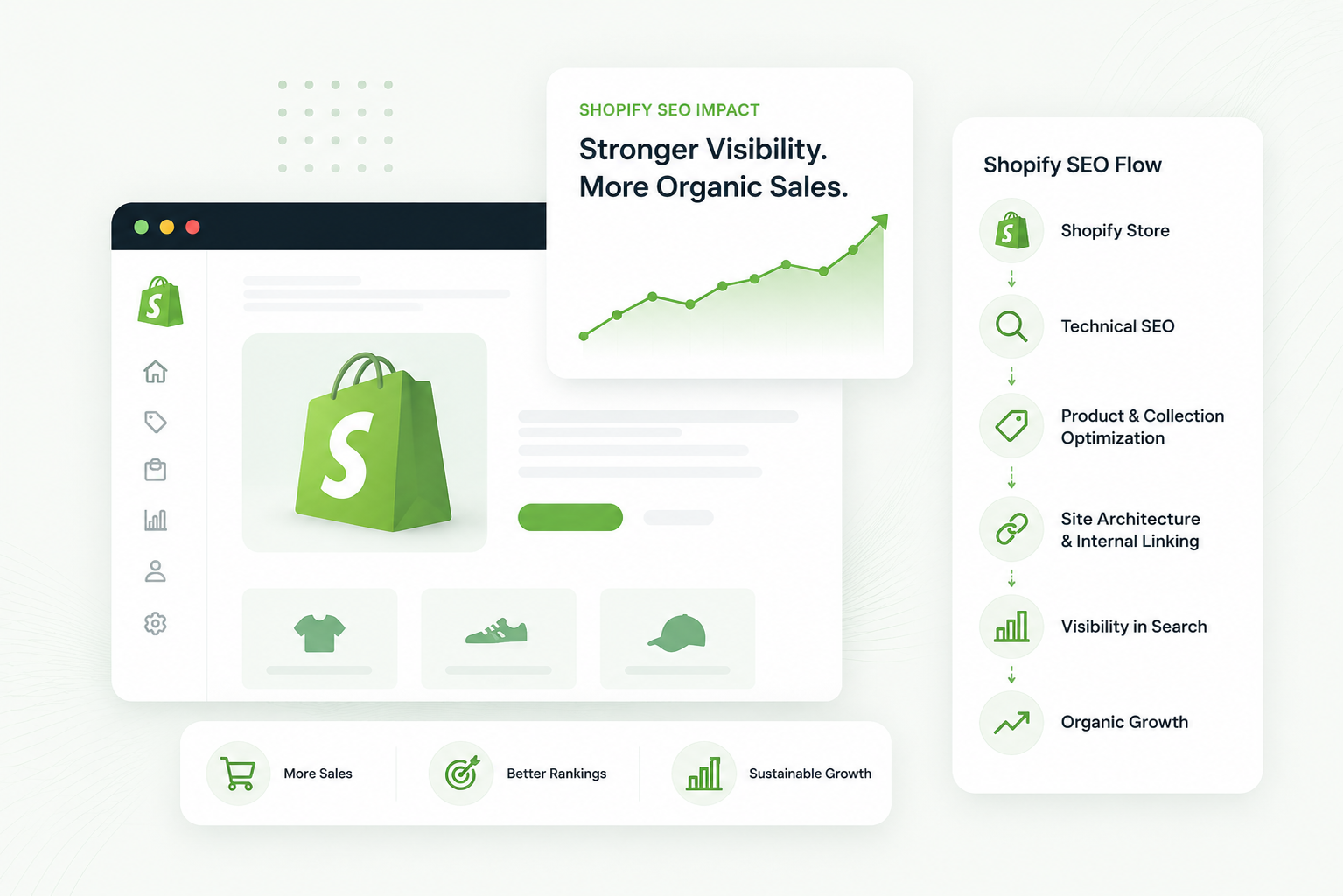
UNDERSTANDING SHOPIFY SEO
Shopify SEO is the process of improving the technical structure, products, collections, content, and internal relationships of a Shopify store so search engines can more effectively discover, understand, index, and surface its important pages.
But Shopify SEO isn't simply about adding keywords to product descriptions.
Shopify has its own platform architecture, URL structure, product and collection system, themes, apps, variants, filters, and technical limitations all of which can influence how search engines interact with your store.
A strong Shopify SEO strategy therefore needs to consider three things together:
Search Demand
Understanding how potential customers search for your products, collections, and related solutions.
Store Structure
Creating clear relationships between products, collections, supporting content, and important commercial pages.
Technical Foundation
Making it easier for search engines to crawl, index, and understand the pages that matter.
Shopify SEO connects search demand, store structure, technical health, and commercial pages to build stronger organic visibility.
The difference isn't simply knowing SEO. It's understanding how SEO works within the Shopify ecosystem.
WHY SPECIALIZATION MATTERS
Shopify makes it relatively easy to build and manage an online store, but its platform structure also introduces specific SEO considerations.
A generic SEO checklist may identify basic issues, but Shopify SEO requires understanding how products, collections, variants, themes, apps, internal linking, and the platform's technical architecture interact.
COMMON SHOPIFY SEO CHALLENGES
Your product pages may lack search-intent alignment, useful product information, internal links, or clear optimization signals.
Important collections may not be properly targeted, structured, optimized, or supported internally.
Search engines may spend resources crawling low-value or duplicate URLs while important commercial pages receive less attention.
Product variants, filters, tags, parameters, and Shopify's URL behavior can create unnecessary or overlapping URLs.
Important products and collections may sit too deep within the store or receive insufficient internal authority.
Themes, apps, scripts, images, and third-party functionality can affect page performance and technical SEO.
Limited or duplicated product information can make it harder to establish relevance and differentiate important pages.
Incomplete, duplicated, or conflicting structured data can make product information harder for search engines to interpret.
WHY SHOPIFY SEO MATTERS
A professionally designed Shopify store doesn't automatically become discoverable in search.
SEO helps connect your products and collections with the searches potential customers are already making.
Product Visibility
Help important product pages become more relevant and discoverable for specific searches.
Collection Visibility
Strengthen collection pages for broader commercial and product-category searches.
Technical Health
Reduce technical barriers affecting crawling, indexation, performance, and search visibility.
Search Intent
Align the right pages with the right searches instead of simply targeting more keywords.
Stronger Internal Relationships
Help search engines understand how products, collections, and supporting content connect.
Sustainable Organic Visibility
Build a search foundation designed to improve over time rather than depending entirely on short-term tactics.
Better Shopify SEO isn't about making every URL rank. It's about making the right pages visible for the right searches.
SHOPIFY SEO CAPABILITIES
Identify relevant search demand and understand the intent behind the queries that matter to your products, collections, and store.
Improve product pages around search intent, relevance, content structure, and the information customers need to make decisions.
Strengthen collection pages so they clearly target relevant commercial search intent and provide useful pathways to products.
Build a clear Shopify store structure that helps search engines and users understand how products, collections, and supporting content are connected.
Create meaningful internal connections between products, collections, and content to improve navigation, relevance, and the flow of authority across the store.
Review canonical signals to help search engines understand the preferred version of important Shopify URLs.
Identify and manage duplicate or overlapping content that can create confusion for search engines or weaken page-level relevance.
Analyze which pages should be discovered and indexed, while identifying unnecessary or problematic URLs that may dilute crawl and indexation signals.
Evaluate Shopify filters, navigation, and URL patterns to help maintain a usable store structure without creating unnecessary search engine complexity.
Organize products, collections, attributes, and related information in a way that creates clearer relationships across the store.
Address technical factors that can affect crawling, indexing, performance, and the overall search accessibility of your Shopify store.
Identify performance-related opportunities that can improve the technical experience for users and support a stronger foundation for search visibility.
MY PROCESS
Understand your business, products, customers, competitors, current performance, and growth priorities.
Business → Products → Customers → Goals
Evaluate technical health, product and collection pages, indexation, content, internal linking, and other factors affecting search visibility.
Technical → Content → Structure → Visibility
Connect search demand and search intent with the most appropriate products, collections, and supporting pages.
Keywords → Intent → Pages
Not every SEO issue deserves equal attention. Prioritize opportunities based on relevance, potential impact, and business value.
Impact → Relevance → Priority
Improve the technical foundation and important commercial pages based on the priorities identified.
Fix → Optimize → Connect
Monitor search performance and use data to refine the strategy over time.
Measure → Learn → Improve
MY APPROACH
I don't approach Shopify SEO as a checklist of isolated optimization tasks.
I look at how your products, collections, technical setup, search demand, internal relationships, and business priorities work together.
E-commerce Focused
My SEO approach is built around the structure and commercial goals of online stores.
Shopify Specific
I consider Shopify's platform architecture rather than treating the store like a generic website.
Search Intent First
Keywords matter, but understanding what customers are actually trying to find determines which pages should compete.
Commercial Pages Matter
Product and collection visibility receives deliberate attention rather than relying entirely on blog traffic.
Technical + Content Together
Technical SEO and page optimization are treated as connected parts of the same search system.
Google + AI Search Awareness
I consider both traditional organic search and how clear site structure, entities, content, and product information can support emerging AI-powered discovery.
My goal isn't to optimize more pages. It's to make better SEO decisions around the pages that matter.
You have an established product catalog and want to build stronger organic visibility.
Your products are live, but important pages struggle to gain meaningful search visibility.
Your collection pages aren't capturing the broader commercial searches relevant to your products.
Indexation, duplication, performance, themes, apps, or other technical issues may be limiting search performance.
You want to build organic search into a more sustainable customer acquisition channel.
You want your products, content, and brand information to be easier to understand across traditional and AI-powered search experiences.
SEO ISN'T ALWAYS THE FIRST ANSWER
SEO can be powerful, but it isn't automatically the highest-priority investment for every Shopify store.
If your business is still validating product-market fit, struggling with fundamental product or pricing issues, or facing major conversion problems, those areas may deserve attention before you invest heavily in organic search.
Likewise, SEO usually requires time to build momentum.
The goal isn't to sell SEO at any cost. It's to understand whether SEO is the right growth opportunity for your store and where it fits within the bigger picture.

I'm Jamshed Bhuiyan, an E-commerce SEO Strategist focused on helping Shopify and WooCommerce brands build stronger organic visibility.
My approach goes beyond rankings. I focus on how search engines understand websites, how customers search for products, and how online stores can structure their pages and information to become more discoverable.
My work sits at the intersection of:
E-commerce + SEO + Search Intent + Technical SEO + AI Search
FREE E-COMMERCE SEO AUDIT
Get a practical review of your Shopify store to uncover technical issues, product and collection page gaps, internal linking opportunities, and other factors affecting organic visibility.
What ecommerce founders, marketing teams and agency partners usually want to know before we start.
Whether your biggest challenge is technical SEO, product visibility, collection performance, internal linking, or simply understanding what to prioritize next, let's start by identifying where your Shopify store stands today.