
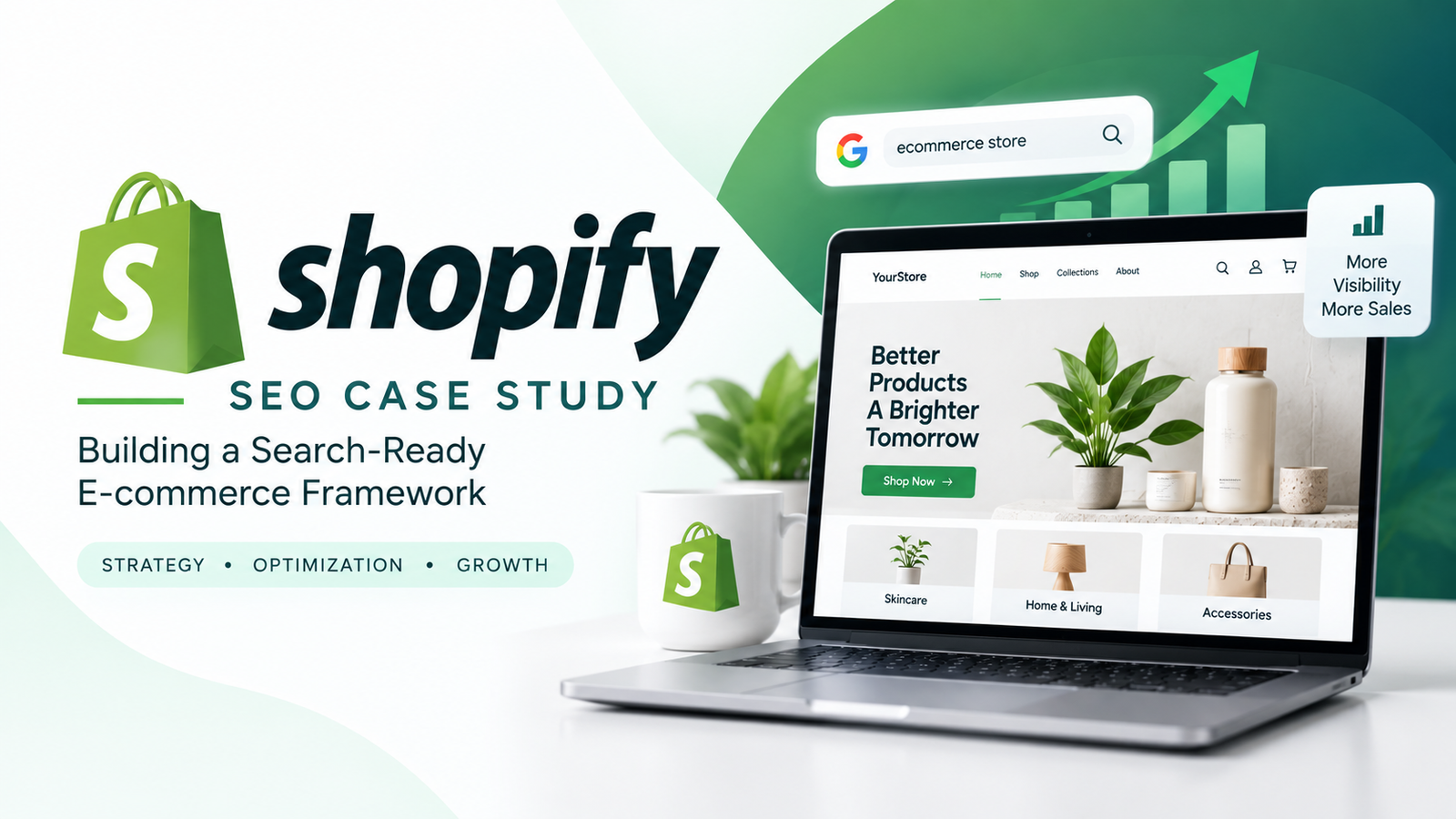
DEMO SHOPIFY SEO CASE STUDY
A demonstration SEO strategy showing how I would approach a Shopify store, from search intent and keyword mapping to collection and product optimization, technical SEO, internal linking, content strategy, and AI search readiness.
Demonstration Project • No Fabricated Results or Client Metrics
PLATFORM
PROJECT TYPE
Demonstration SEO Strategy
PRIMARY FOCUS
Technical SEO, Collection & Product Optimization
GOAL
Build a Search-Ready E-commerce Framework
THE SCENARIO
This demonstration project represents a growing Shopify store with a solid product offering but an underdeveloped SEO foundation. The store has opportunities to improve how its collections, products, content, and technical structure support organic search visibility.
My first step would be to understand where search demand exists, how customers search for the products, and which technical or structural issues could limit visibility.
Collections and product pages are not clearly mapped to relevant search intent.
Important commercial pages lack enough context and optimization to compete for high-intent searches.
Crawlability, indexation, internal architecture, and technical signals need a systematic review.
Commercial pages are not sufficiently supported by contextual internal links and informational content.
HOW I WOULD ASSESS THE STORE
Before recommending optimizations, I would build a clear picture of the store’s search landscape, technical health, commercial priorities, and existing content. The goal is to identify what needs attention first, and why.
Identify buyer-intent keywords, informational searches, and how search demand should map to collections, products, and supporting content.
Review crawlability, indexation, canonicals, duplicate URLs, site speed, structured data, and other technical signals that may affect discoverability.
Evaluate collections and priority product pages for search intent alignment, content depth, metadata, usability, and optimization opportunities.
Assess whether supporting content and internal links help search engines and users discover the store’s most important commercial pages.
KEYWORD STRATEGY
Instead of targeting keywords randomly, I would map each search query to the page type that best matches its intent. This helps prevent keyword cannibalization and gives collections, products, and supporting content a clearer role in the store’s organic search strategy.
KEYWORD / TOPIC
SEARCH INTENT
TARGET PAGE
PAGE ROLE
PRIORITY
indoor plant pots
Commercial
Collection
Primary category targeting
High
ceramic plant pots
Commercial
Collection
Subcategory targeting
High
self watering plant pot
Transactional
Product / Collection
Product-led demand
High
best pots for indoor plants
Informational / Commercial
Blog Guide
Support collection discovery
Medium
how to choose a plant pot
Informational
Blog Guide
Build topical relevance
Medium
KEYWORD STRATEGY
Instead of targeting keywords randomly, I would map each search query to the page type that best matches its intent. This helps prevent keyword cannibalization and gives collections, products, and supporting content a clearer role in the store’s organic search strategy.
KEYWORD / TOPIC
SEARCH INTENT
TARGET PAGE
PAGE ROLE
PRIORITY
indoor plant pots
Search intent
Commercial
target page
Collection
page role
Primary category targeting
priority
High
ceramic plant pots
Search intent
Commercial
target page
Collection
page role
Subcategory targeting
priority
High
self watering plant pot
Search intent
Transactional
target page
Product / Collection
page role
Product-led demand
priority
High
best pots for indoor plants
Search intent
Informational / Commercial
target page
Blog Guide
page role
Support collection discovery
priority
Medium
how to choose a plant pot
Search intent
Informational
target page
Blog Guide
page role
Build topical relevance
priority
Medium
SITE ARCHITECTURE
After mapping keywords to the right page types, I would organize the store so search engines and users can clearly understand how collections, products, and supporting content relate to each other. The goal is to create a structure that supports discoverability, internal linking, and commercial page visibility.
Establish the store’s core brand relevance and provide clear navigation paths to the most important commercial categories.
Role: Brand Hub & Primary Navigation
Organize products around shared search intent and target high-value commercial queries through optimized collection pages.
Role: Primary Commercial SEO Pages
Support specific product-level searches with clear product information, relevant content, structured data, and contextual internal links.
Role: Transactional & Product-Level Visibility
Create informational content around customer questions and related topics, then connect that content back to relevant collections and products.
Role: Topical Authority & Internal Linking
COLLECTION PAGE STRATEGY
Collection pages would be a major SEO priority because they can target broader, high-intent searches while helping users discover relevant products. My approach would combine search intent, useful category content, on-page optimization, internal linking, and product discovery without turning the page into an SEO-only experience.
• Generic or missing collection copy
• Weak keyword and search-intent targeting
• Limited internal links from supporting content
• Thin metadata and contextual relevance
• Products listed without a clear SEO hierarchy
• Map one primary commercial intent to the collection
• Add useful category-level content for shoppers
• Optimize titles, headings, metadata, and supporting copy
• Build contextual internal links from relevant content
• Strengthen product discovery and topical relevance
PRODUCT PAGE STRATEGY
Not every Shopify product page needs to target a separate high-volume keyword. I would prioritize products with meaningful search demand and optimize them around specific product intent, while ensuring every important product page provides clear information for users and strong contextual signals for search engines.
Match priority products with specific transactional or product-level searches instead of forcing keywords onto every product page.
Strengthen titles, descriptions, specifications, FAQs, and other useful information that helps customers evaluate the product.
Review indexability, canonicalization, structured data, image optimization, and other technical elements that support product discovery.
Connect products with relevant collections, guides, and related products to strengthen discovery and contextual relevance.
TECHNICAL SEO
A strong content strategy cannot perform effectively if search engines struggle to crawl, understand, or index the store. I would review the technical foundation to identify issues that could limit discoverability, page quality, and organic search performance.
Review robots directives, XML sitemaps, indexability, redirects, and crawl paths to ensure important pages can be discovered and indexed correctly.
Check Shopify URL variations, duplicate content patterns, canonical signals, and unnecessary indexed URLs that could dilute search relevance.
Review page performance, image delivery, scripts, theme elements, and other factors that may affect speed and user experience.
Review product, breadcrumb, organization, and other relevant structured data alongside essential technical signals that help search engines understand the store.
INTERNAL LINKING STRATEGY
Internal linking would connect informational content with the store’s most important commercial pages, helping users move naturally from research to product discovery while giving search engines clearer signals about page relationships and priority.
Answer customer questions, target informational searches, and create contextual links toward relevant commercial pages.
Act as the central commercial hub, receiving internal authority from supporting content and guiding shoppers toward relevant products.
Receive contextual links from collections and relevant guides to support product discovery and product-level search visibility.
CONTENT STRATEGY
Supporting content would be planned around the questions and problems customers search for before making a purchase. Instead of publishing disconnected blog posts, I would build topic clusters that support relevant collection pages, strengthen topical relevance, and create natural internal linking opportunities.
Guide shoppers through size, material, drainage, and use-case considerations before purchase.
Target informational and commercial research intent while naturally supporting the main collection page.
Answer comparison-based searches and guide relevant users toward suitable product categories.
Primary commercial hub targeting high-intent searches and connecting shoppers with relevant product categories.
Role: Primary Commercial Collection Page
AI SEARCH READINESS
As search evolves beyond traditional results, I would structure the store’s content so that search engines and AI systems can more easily understand products, collections, and expertise. The focus would be on clear entities, useful answers, structured information, and strong contextual relationships, not on trying to manipulate or guarantee AI visibility.
Structure product, collection, brand, and supporting content so their relationships and meaning are easy to understand.
Address important customer questions clearly through useful collection copy, product information, FAQs, and supporting guides.
Use appropriate structured data and consistent page information to help machines interpret products, breadcrumbs, organization details, and other relevant entities.
Strengthen authorship, business information, policies, supporting evidence, and content quality so the store provides clearer signals of credibility.
SEO ROADMAP
Rather than trying to address every SEO issue at once, I would organize the work into clear phases based on technical importance, search opportunity, commercial value, and implementation dependency. This creates a practical sequence for strengthening the store’s search foundation and expanding organic visibility over time.
Crawlability, indexation, canonicals and critical technical issues
Keyword mapping, collections and priority product pages
Supporting content, topic clusters and internal linking
Visibility, indexing, commercial-page performance and next priorities
MEASUREMENT FRAMEWORK
Because this is a demonstration strategy rather than a completed client project, I am not presenting fabricated traffic, ranking, or revenue results. If implemented on a real Shopify store, I would evaluate progress using search visibility, technical health, commercial-page performance, and organic business outcomes.
Track impressions, clicks, keyword visibility, and the search queries driving discovery.
Monitor index coverage, crawl issues, Core Web Vitals, structured data, and other technical signals.
Evaluate how priority collections and product pages perform in organic search and attract relevant visitors.
Connect SEO performance with qualified organic traffic, product discovery, conversions, and revenue where reliable analytics data is available.
KEY TAKEAWAYS
This demonstration shows how I would connect technical SEO, search intent, commercial page optimization, internal linking, content strategy, and AI search readiness into one structured Shopify SEO approach rather than treating each area as an isolated task.
Keywords should map to the pages that best match what shoppers are actually searching for.
Collections and priority products become stronger when technical foundations, supporting content, and internal links work together.
Technical health, content, internal relationships, and performance data should continuously inform the next optimization priorities.
TRANSPARENCY NOTE
This is a demonstration Shopify SEO case study created to showcase my strategic thinking, research process, and approach to e-commerce SEO. It is not presented as a completed client project. Any examples, keyword mappings, page structures, or recommendations shown here are illustrative, and no fabricated traffic, ranking, conversion, or revenue results have been used.
READY TO IMPROVE YOUR STORE’S SEARCH VISIBILITY?
Whether you run a Shopify or WooCommerce store, I can help you identify SEO opportunities, prioritize the right improvements, and build a practical strategy around your business goals.